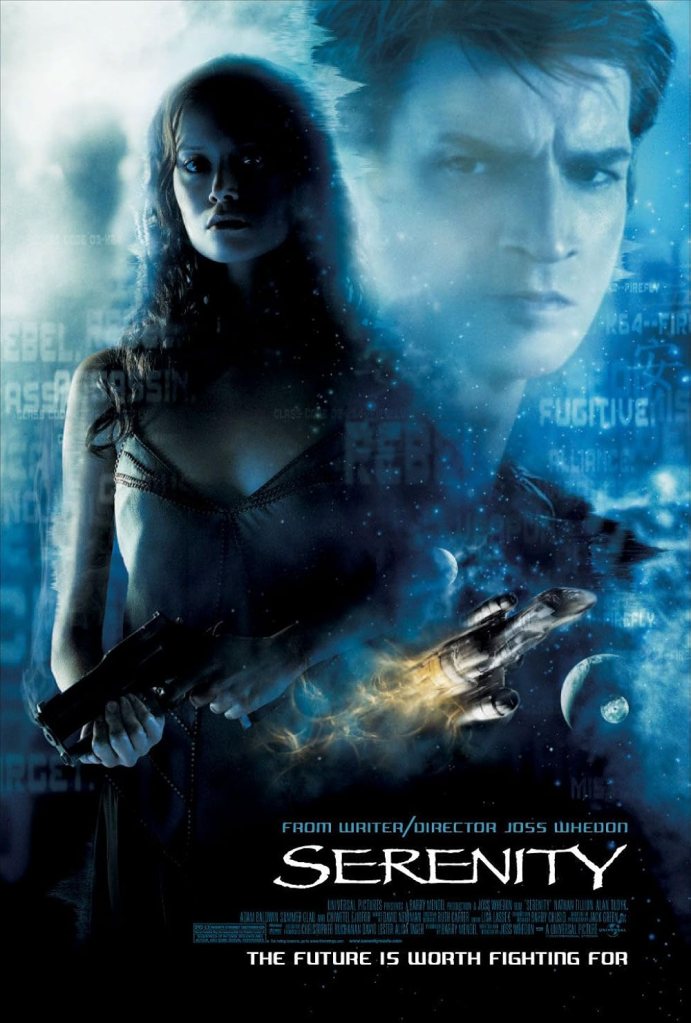
Serenity (2005) is a film follow-up to Joss Whedon’s Firefly franchise that mixes the space western genre with science fiction, featuring western tropes such as the cowboy with its gear, posse, guns, saloons, and shootouts while offering a timely commentary on the culture of fear, fear of the outsider as well as authoritarianisms of the early 2000s. The film reflects on a broader culture of fear in which governments and scientific institutions attempt to prevent “threats” by increasingly intervening in and controlling human life. Reflectively, Serenity does not shy away from portraying an authoritarian empire that uses programs of subjectification, experimentation, chemical drugs as well as brainwashing mechanisms of the Alliance (the authoritarian interplanetary government that controls most of the known galaxy).
In classical western movies, the narrative is mostly comprised of a division between the old world and a new world, out of which the urge to conquer the frontier occurs almost consistently. As stories and flashbacks of the past haunt the present, pioneers conquer unfamiliar frontier territories by donning rugged masculine roles, fighting against villains, and protecting and guiding innocent people in a savage, wild, uncanny, and untamed landscape. In this respect, Captain Malcolm Reynolds fits the cowboy archetype, whose crew commissions itself to act in the name of humanity and fight against an authoritarian empire that subordinates and subjugates free people in outer space. The western trope is generally about expanding the frontier and conquering territories imagined as open to settlement and taming by the cowboy but the hero’s journey of self-discovery, which requires an inner journey into unconscious fears, is also evident in space westerns. In this respect, River Tam, a traumatized young woman who was experimented on by the Alliance and later rescued by her brother, undergoes a journey of reliving her psychosis and coming to terms with her past as her memories are triggered through fragmentary flashbacks that ultimately reveal the collective unconscious horror haunting the crew and, more broadly, all those who represent free will: the Reavers.
The Reavers are archetypes of the evil destroyers of the progress that mankind has achieved by expanding into space, which functions as the last frontier. They are, however, also representations of what has gone wrong with humanity: It is initially believed that they ventured deep into the edges of space and encountered a “nothingness” that drove them mad. They, to me, echo the lost souls who walk away from Omelas in Ursula K. Le Guin’s seminal story, where peace and prosperity are said to depend upon a repressed evil, even though the narrative leaves room to question whether that suffering is truly necessary for the society to exist. A similar logic underlies the Alliance’s attempt to manufacture peace on Miranda, where collective stability and safety are pursued through the suppression of aggression and individual will. However, as the film later exposes, this experiment, carried out through the use of Pax, a chemical agent designed to remove aggression, ultimately creates the Reavers.
These flesh-eating monsters, the Reavers, follow the origins of the zombie trope in the sense that the Reavers are reflections of the greed, exploitation, and manipulation of repressive regimes. The origins of the zombie figure also point to its function as a representation of desensitized, dull, and non-questioning beings who are both devoid of free will and controlled by an exploiting authority, as can already be seen in Victor Halperin’s White Zombie (1932) (widely regarded as the first feature-length zombie film) where zombified workers are enslaved and controlled by a powerful master. In a similar vein, the Reavers were the result of a biological experiment on Miranda. The population was subjected to a specific drug that pacified citizens so effectively that most simply stopped working and eventually waited for death to claim them.
This yearning for death might be inherent in the human psyche yet the Reavers are portrayed in such a way that they come to represent not only the dark side of repressed, uncanny horrors deeply buried within the human unconscious, but specifically intelligent monstrosities driven by an animalistic urge to cannibalize and destroy. They therefore embody what happens when the attempt to repress human impulses produces the very violence that it seeks to eliminate.
It again falls to the hero who fits the cowboy archetype of the classical western, together with his posse in the form of a crew, to expose the evil face of the Alliance that created the Reavers in the first place. Captain Mal changes his tactics from wanting to hide from the Alliance to actively challenging it by transmitting the origin story of the Reavers throughout the galaxy in an attempt to shake off the authority of its political mechanisms.
Captain Mal therefore becomes a Christ figure: he is prepared to sacrifice himself for what he believes is right but he is also a messenger attempting to spread the truth after being spiritually influenced by Shepherd Book, who is killed by the unnamed assassin working for the Alliance. The religious undertones of the film, particularly its emphasis on believing in what is right as part of the archetype of the hero, are evident in Mal’s actions. He demonstrates to the nameless Alliance assassin that his ultimate belief in his cause is the driving force behind his resistance.
It is as if Mal is destined to succeed against the evil represented by the Alliance, which eventually propels the assassin to let him and his crew go unharmed despite the Alliance’s orders. In a way, the assassin discovers a stronger and higher power than that represented by the Alliance in Captain Mal’s conviction, causing him to break ties with the repressive political system he has long been serving. The conflict between the two characters therefore becomes not simply a physical struggle but also a confrontation between competing forms of belief: the Operative’s faith in the Alliance and Mal’s belief in resistance, free will and the necessity of exposing the truth.

Leave a comment