Ridley Scott’s Blade Runner (1982) portrays a futuristic world where the central question revolves around what it means to be human, which is problematized against the backdrop of the mass production of human-like replicants by a capitalist enterprise named the Tyrell Corporation. The purpose of the Tyrell Corporation is to provide the muscle and workforce for off-world colonies by creating replicants programmed to live for a short span of four years. As experiments by Dr. Eldon Tyrell and each successive model bring replicants closer to humans, a group of fugitive Nexus-6 replicants attempt to overcome the death programmed into their coding. Blade Runners, a special police force tasked with eradicating illegal replicants, are nevertheless in short supply, and it falls to former police officer Rick Deckard (played by the dashing Harrison Ford) to eliminate the threat.
This plot then propels a journey through which the audience is encouraged to question the moral and religious implications of the futuristic world of Blade Runner. The moral dilemma of the film is most strongly embodied in the philosophizing of Roy Batty, the leader of the fugitive replicants. Batty questions the creation of Nexus-6 models that are programmed and manufactured to serve as slaves to humans while physically resembling to their human masters. Even the language surrounding replicants politically justifies their eradication: they are “retired” rather than killed, allowing society to deny that their destruction constitutes death.
Dr. Tyrell’s vision of replicants is also restrictive and deeply unsatisfying for Batty, who ultimately kills his maker. Here, the film toys with the Frankensteinian myth of the creation turning against the creator who has condemned it to an abject existence that is neither fully human nor machine. Batty’s final confrontation with Deckard foregrounds the moral flaw inherent in creating artificially intelligent beings capable of experiencing fear, love, loneliness, joy as well as isolation while denying them the right to determine their own existence. Replicants can simply be replaced by another model when they are decommissioned, and their destruction is not regarded as death even though they are genetically engineered to experience emotions remarkably similar to those of humans.
Furthermore, the capitalist exploitation of replicants by the Tyrell Corporation, which sends them to off-world colonies as slave labor, represents a deeply layered social order in which replicants are reduced to the status of either slaves or criminals once they rebel against the system. The film makes use of a common science-fiction trope enhanced by the Frankensteinian myth: Dr. Eldon Tyrell’s motto, “more human than human,” encapsulates the contradiction of creating beings capable of approximating humanity while refusing to recognize them as human. In creating this post-human order, Tyrell assumes the position of god and maker, disrupting the supposedly natural distinction between human and replicant and ultimately producing destruction, confusion, and rebellion.
In this futuristic world (inspired by the great Philip K. Dick’s Do Androids Dream of Electric Sheep?),humanity has few tools at their disposal to differentiate humans from replicants. Replicants are said to be inexperienced when overwhelmed by emotions that remain relatively unfamiliar to them, even though Tyrell attempts to implant memories into advanced replicants such as Rachael in order to minimize the differences between artificial and human consciousness. The law therefore relies on the Voigt-Kampff machine, an empathy test used by the police to identify replicants. The test asks a series of emotionally provocative questions and evaluates the subject’s responses to determine whether they are human or replicant. It measures involuntary reactions in the iris alongside physical responses such as blushing, embarrassment, respiration, and response time. Interestingly, many of the questions involve the killing or mistreatment of animals and human beings, making empathy itself the defining measurement of humanness. Yet, this distinction becomes increasingly unstable as the film progresses. Deckard’s growing dissatisfaction with his profession signifies how difficult it has become to distinguish replicants from humans and, more importantly, whether making such a distinction remains morally defensible at all.
Such ambiguity is particularly evident when Deckard tests Rachael, an advanced replicant whose mind has been implanted with memories that make her believe she is human. She comes remarkably close to passing the test, demonstrating how increasingly inadequate such methods of differentiation have become. If memories can be manufactured and emotions can be experienced by replicants, the film begins to question whether biological origin alone is sufficient to define humanity.
Batty’s insistence on finding a way to extend the lifespan of replicants is closely associated with his portrayal as a Christ-like figure. During his final confrontation with Deckard, he drives a nail through his hand, later saves Deckard from falling to his death, and dies while holding a white dove that is released into the air. The religious imagery surrounding Batty becomes particularly significant because the supposed criminal displays mercy toward the man assigned to kill him. His final act therefore reverses the moral positions established at the beginning of the film: the replicant hunted as an inhuman threat becomes capable of compassion, while human society remains responsible for enslavement, exploitation, and extermination.
Roy also functions as a spiritual leader of the fugitive Nexus-6 replicants, repeatedly reflecting on the injustice of their existence and the cruelty of the corporate system that created them. Another significant example of Roy’s portrayal as a Christ figure occurs during his encounter with Tyrell. The maker calls him the “prodigal son,” introducing a biblical relationship between creator and creation. Tyrell functions as the god of biomechanics, while Batty’s killing of his maker takes on ritualistic dimensions: killing the creator signifies a violent attempt to break away from the bondage imposed upon the replicants by humanity. In this respect, the film forces one to question whether Batty is truly the criminal or rather a rebel and potential savior hunted by a society that refuses to acknowledge his humanity.
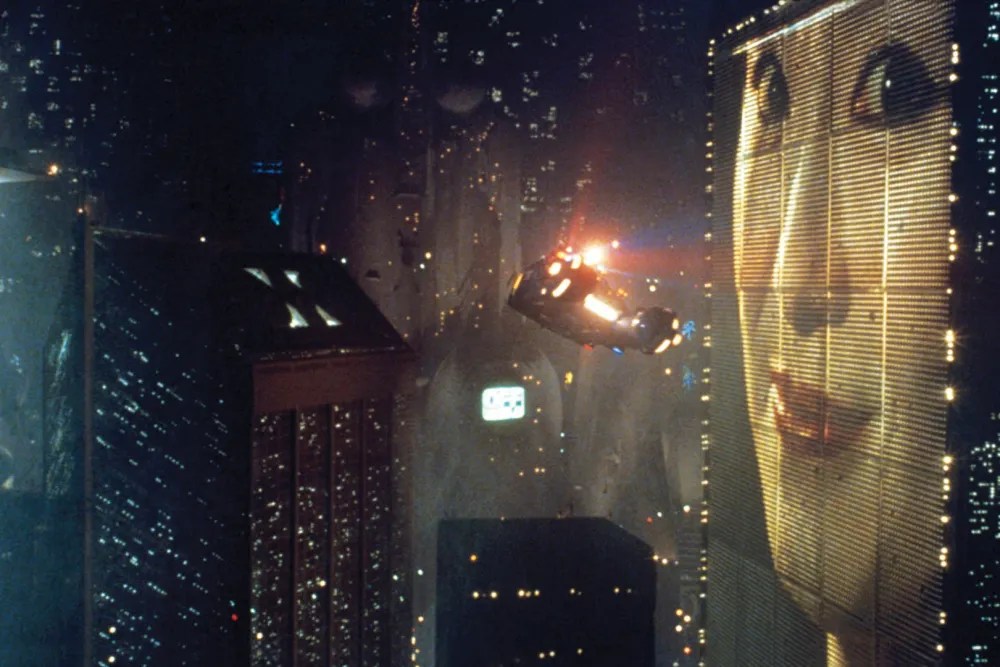
It is also crucial to note that the Earth depicted in the film is an ecologically devastated world where natural animals, trees, and plants are almost entirely absent. Scenes are repeatedly obscured by smoke, darkness, industrial structures, and an atmosphere of environmental decline. Earth is no longer presented as the most desirable place to live. Instead, those who remain are largely people unable to migrate to the supposedly better life offered by the off-world colonies. The social hierarchy of the film therefore extends beyond the distinction between humans and replicants, revealing a world divided by mobility, health, labor, and economic privilege.
Whether Deckard himself is a replicant has long remained one of the film’s central ambiguities. Certain elements, particularly the unicorn imagery, can be interpreted as suggesting that his memories may also have been implanted. Batty’s decision to save Deckard can consequently be read not only as an act of mercy but also as an acknowledgment of a shared condition. Regardless of whether Deckard is biologically human or replicant, however, Batty’s final act demonstrates precisely the empathy that replicants supposedly lack. Saving Deckard becomes an act of forgiveness and a final assertion of Batty’s humanity.
This final act of mercy ultimately destabilizes the distinction the film has spent its entire narrative constructing. If replicants can fear death, preserve memories, experience love, rebel against slavery, show compassion, and mourn the loss of others, the question of whether they technically qualify as human begins to lose its significance. This is where Blade Runner excels as both science fiction and philosophical cinema: rather than providing a definitive answer to what makes someone human, it gradually makes the distinction itself impossible to sustain. Its bleak futuristic city, corporate dystopia, religious symbolism, and moral ambiguity complement a story in which the supposedly artificial beings often demonstrate greater humanity than their creators. More than four decades later, this ambiguity remains one of the reasons Blade Runner continues to stand as a defining cult-classic of science-fiction cinema.

Leave a comment