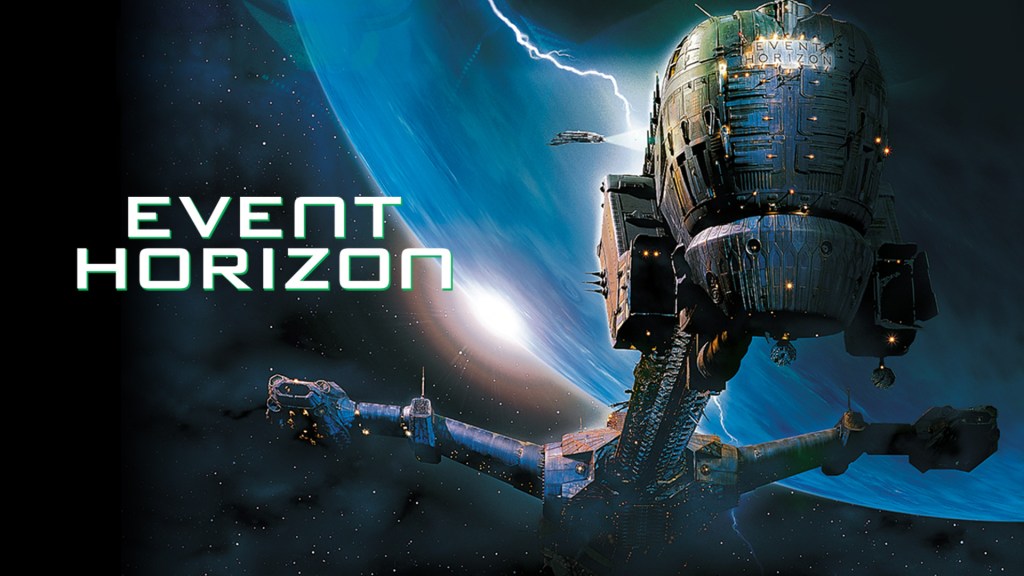
Paul W. S. Anderson’s Event Horizon (1997) is a nice blend of science fiction and horror, featuring a futuristic setting in 2047 when humanity has managed to colonize the Moon. The urge to colonize other planets propels secret governmental projects such as the Event Horizon, which is developed in an attempt to travel deeper into space. The Event Horizon is powered by a core gravity drive that provides a gateway into other realms by distorting the traditional functioning of space and time. It creates an artificial black hole, making faster-than-light travel possible. When the ship is sent into deep space near Neptune, communication with it gets lost but only for a distress signal to be picked up years later. What makes this unusual is that the research vessel had actually disappeared without a trace, becoming one of the worst space-exploration disasters that is ever recorded with eighteen crew members presumed dead. The film could eventually be read as a commentary on and critique of a devastating anthropocentric vision driven by an endless desire to mine, exploit and colonize increasingly distant worlds.
The project’s designer, Dr. William Weir, is tasked with recovering the ship by joining the crew of the rescue vessel Lewis and Clark which is commanded by Captain Miller. Weir is a character tormented by memories of his dead wife, just as Miller is haunted by his failure to save a close friend who died horribly. The film does a good job at presenting the psychological torture experienced by each character, which the ship eventually uses to drive them insane. Weir’s troubled psyche is exemplified early in the film when he wakes abruptly from hypersleep and wanders through what appears to be an empty ship. As he makes his way through the vessel, he encounters his late wife Claire sitting alone, turning his grief into a source of horror.
After the crew awakens from hypersleep, they learn the true nature of the mission. Weir’s revelation that they have been sent to salvage the Event Horizon immediately creates a sense of paranoia, which is reflective of the fear of the unknown that lies at the center of Lovecraftian cosmic horror. In their attempts to make the unknown knowable, they rely on the limited vocabulary and explanatory systems available. In this respect, the film ultimately ends up offering a religious framework through which its characters attempt to understand the cosmic horror confronting them. The evil source of psychological torment emanating from the ship is associated with a realm of pure chaos that resembles a vision of hell. However, what the Event Horizon has encountered ultimately exists outside ordinary human vocabulary and comprehension. After traveling into the unknown, the ship itself appears to acquire a form of consciousness, becoming almost alive and actively manipulating those who enter it. The use of Latin further reinforces Christian symbolism as the characters struggle to interpret an incomprehensible threat. This force enters the human mind, drawing upon deeply buried trauma, guilt and fear as well as manipulating these psychological vulnerabilities to the point of madness, violence and suicide.
The film’s sci-fi novum includes, among many other innovative designs and alien-like interiors, hypersleep or cryosleep pods that make it possible to preserve the bodies of crew members during long-distance space travel. Advanced communication technologies and tablet-like devices similarly contribute to the futuristic design of the film’s world. More significant, however, is the gravity drive itself which allows the ship to create an artificial black hole and cross distances that would otherwise be impossible. What initially appears to be humanity’s greatest technological achievement instead becomes the mechanism through which humanity encounters something it is incapable of understanding or controlling.
The recovered video log from the Event Horizon reveals an orgy of gore, death and violence, exposing how the minds of the original crew were manipulated by the unknown force encountered during the ship’s journey. The film combines extreme gore with hellish imagery and demonic visions, particularly through Weir’s transformation, suggesting that the source of this cosmic horror lies far beyond conventional human understandings of evil, hell, fire and eternal damnation. The characters can interpret what they encounter only through familiar religious imagery even though the force itself may exceed such explanations entirely.
The conclusion where the fate of the Event Horizon and the threat it has unleashed remain uncertain reinforces the film’s cosmic-horror dimension. The possibility that this force may continue to exist somewhere beyond human perception suggests that humanity has opened a gateway to something it was never prepared to encounter. The brutality of the visions and the overwhelming fear of the unknown come into full force when the cosmos turns against a humanity incapable of fully comprehending what it has discovered. In this vein, Event Horizon works particularly well as a critique of human arrogance, reducing humankind’s technological confidence to insignificance when confronted with the unknowable scale of the vast unknown. Its strongest achievement lies in the way it merges sci-fi, psychological horror, striking religious imageries and (perhaps most importantly) the cosmic dread, turning humanity’s desire to conquer space into a deeply unsettling warning about the limits of scientific ambition and human understanding.

Leave a Reply