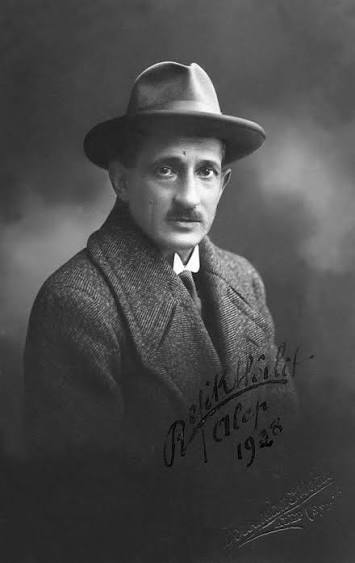
Refik Halid Karay’s short story Hülya Bu Ya (1921) is considered one of the earliest examples of science-fiction in Turkish literature, imagining a futuristic Ankara through the eyes of an American journalist named Mr. Con. The short story does not simply follow Mr. Con’s account of this technologically advanced city. It is structured in a way that allows the author to make political commentary on the emerging political order centered around Ankara. The author appears particularly skeptical of the political vision that would establish Ankara as the center of the new Turkish republic. Even though each scientific invention created by the real and pioneering figures associated with this new order leaves the American journalist in awe of Ankara’s utopian advancement, subtle criticisms by the journalist (also indirectly by Refik Halid) accompany this seemingly enthusiastic portrayal.
The novum exemplified in the short story are fascinating and wondrous: moving sidewalks, devices that control the climate and weather, cloning machines, teleportation, a soul-reading device, cybernetic technologies that replace body parts and eliminate the fear of death, as well as improved versions of the telephone that make long-distance communication possible are among the inventions demonstrating not only the superiority of Ankara as a city designed for greatness but also the scientific advancement of its government. Its vision of the future disallows idleness, encourages work, and values science and positivism over traditionalism and religious thinking. Yet, the exaggeration of such achievements also makes their supposedly utopian character increasingly questionable. Refik Halid’s political opposition to the nationalist movement and his subsequent exile make it difficult not to sense the irony behind the extraordinary inventions witnessed by Mr. Con.
The first inventions introduced to the reader are moving sidewalks that provide quicker transportation and a climate-control device that ensures a permanent source of water for the inhabitants. This accumulator, invented by engineers of the new political order, collects sunlight to illuminate the dark sky at night while also collecting drops of water before they reach the surface, which then allows for rainfall to be controlled in order to combat drought. It even reduces the possibility of catching a cold while illnesses themselves can easily be cured by cybernetic technology that is even capable of creating artificial organs to replace failing ones.
The fact that representatives do not have to be physically present in parliament to voice their opinions and make crucial decisions is another revealing aspect of Refik Halid’s futuristic Ankara. A revolutionary device makes what we would now call teleconferencing possible, but the invention also becomes a vehicle for political satire. The description draws attention to representatives who simultaneously occupy positions as ministers, managers, and commanders, while the technology itself contains a small button that determines who is allowed to speak and who can simply be muted. Scientific advancement therefore does not necessarily produce greater political freedom. On the contrary, the same technology that promises efficiency also makes silencing opposition remarkably easy.
The exclusive policies of the Ankara government are similarly satirized through a device that determines who is permitted to enter the capital. A person must possess a pure soul and good character before being granted entry, qualities conveniently determined by the machine itself. The absurdity of objectively measuring a person’s moral worth reflects the exclusion of individuals whose ideas do not conform to those of the political establishment. Refik Halid’s own experience of political exclusion makes this aspect of the story particularly striking.
The positivist and science-oriented vision of the new order is further satirized through the ironic juxtaposition of American and Turkish progress. The sleeping device, for instance, maximizes productivity by reducing the amount of rest required by workers, turning even sleep into something that must be reorganized in the service of rapid economic transformation. The futuristic Ankara imagined by Refik Halid therefore appears obsessed not simply with scientific progress, but with efficiency, productivity, and the creation of ideal citizens capable of sustaining this progress.
The most interesting invention encountered during Mr. Con’s journey through the city, however, is the human cloning machine. It creates new members of society who can be educated and prepared for social life within approximately a month. The newly created citizen is immediately subjected to an intensified educational process, including university education, ensuring the continuation of the political and ideological order. The cloning machine therefore becomes more than a technological marvel: it represents the possibility of manufacturing the ideal citizen. Read critically, Refik Halid’s satire suggests that such attempts to produce perfectly adapted members of society risk deadening individuality and replacing intellectual development with ideological conformity.
The screens Mr. Con encounters in the cinema also become particularly interesting when read from a contemporary perspective. They anticipate later dystopian representations of technology as an instrument through which citizens can be observed, influenced, and controlled. Rather than treating technological development as inherently liberating, Hülya Bu Ya repeatedly imagines inventions whose promises of convenience and progress conceal their capacity for surveillance, discipline, and ideological control.
Overall, the story can be read not simply as a criticism of the emerging political order centered around Ankara but also as a skeptical response to an increasingly scientific and positivist understanding of progress. What makes Hülya Bu Ya particularly interesting as an early work of Turkish speculative fiction is this ambiguity: the inventions witnessed by Mr. Con are genuinely extraordinary, yet almost every technological achievement contains within it the possibility of greater control. Scientific advancement eliminates illness, overcomes distance, regulates nature, increases productivity, and even manufactures human beings, but it does not necessarily produce a freer society. Refik Halid instead pushes technological progress toward absurdity in order to question what happens when modernization, political ideology, and scientific advancement become inseparable. The futuristic Ankara that initially appears utopian consequently becomes much more ambiguous—a technologically advanced city whose pursuit of perfection risks sacrificing individuality and freedom.

Leave a comment