Nacho Vigalondo’s Timecrimes (2007) is a gripping science-fiction film that transforms the familiar time-travel trope into a remarkably linear film, centering on a never-ending time loop created by an experiment gone wrong. The film contains very little dialogue, allowing suspense to emerge through visual storytelling as it portrays the tragedy of a seemingly ordinary man, Héctor, caught in an increasingly complex web of temporal paradoxes. As multiple versions of himself attempt to correct previous mistakes, each intervention only generates further complications for the main character. The underlying premise of the film is that time travel is incapable of correcting the past. Instead, every attempt to alter events merely reinforces the inevitability of the said loop.
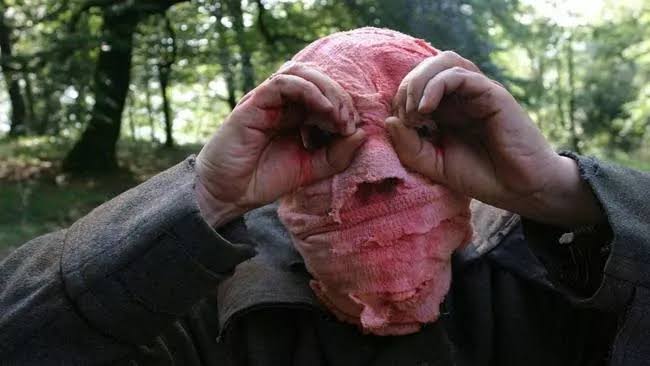
The film begins in a peaceful rural valley, introducing Héctor and his wife as they renovate their country home. What immediately distinguishes Héctor is his voyeuristic tendency, as he spends his afternoon observing the surrounding woods through a pair of binoculars. After noticing a young woman undressing in the forest, he follows her into the woods, only to be attacked and stabbed in the arm by a mysterious figure whose face is concealed beneath pink bandages. This attacker is eventually revealed to be another version of Héctor himself. Fleeing through the forest, Héctor discovers a walkie-talkie and contacts a scientist, who directs him toward an experimental laboratory. There, Héctor is persuaded to hide inside a large steel tank with a hydraulic lid that resembles an enclosed womb. The imagery of the tank carries clear psychoanalytic undertones: each Héctor who emerges from this artificial womb adopts a different strategy in an attempt to restore the timeline, only to discover that returning events to their “proper” order is impossible.
Once submerged inside the machine, however, Héctor emerges covered in a white fluid and discovers that another version of himself is already at home with his wife. The scientist immediately realizes that Héctor has traveled backwards in time and explains that another Héctor now occupies his previous position in the timeline. The safest solution, as he insists, is simply to remain hidden until the earlier version inevitably arrives at the laboratory and enters the machine, thereby restoring the existence of a single Héctor. Unable to accept this advice, Héctor then steals a car and attempts to return home.
On the way, Héctor encounters the same young woman he had previously observed in the woods. Before he can approach her, another version of himself—Héctor 3—collides with his vehicle, further complicating the already fractured timeline. In an attempt to lure Héctor 1 into the woods and preserve the sequence of events, Héctor manipulates the young woman into participating in his plan. Here, the forest itself functions as an important symbolic space. From a Jungian perspective, the woods frequently operate as a maternal symbol, representing both psychological descent and the possibility of transformation. The juxtaposition of the vulnerable young woman with the bandaged slasher figure armed with oversized scissors also reinforces Héctor’s voyeuristic impulses and latent fetishism. His insistence that the woman scatter her clothing throughout the forest in order to recreate the events he previously witnessed further reveals the extent to which his own desires become entangled within the logic of the time loop.
One of the film’s most intriguing aspects lies in the way it structures its time-travel narrative around a single protagonist confronting different versions of himself. Instead of utilizing time travel simply as a spectacular device, the Spanish director Nacho Vigalondo turns it into a psychological confrontation through which Héctor is forced to witness his own voyeurism, selfishness, capacity for violence, and, ultimately, his devotion to his wife. The film imagines what would happen if an ordinary individual became trapped within a temporal loop from which no genuine escape exists. Every attempt Héctor makes to correct his mistakes merely produces another iteration of himself and generates further temporal chaos as well as disorder.
The film is also structured so that each successive version of Héctor appears either to evolve morally or to descend further into manipulation and violence. Another fascinating aspect of the film’s narrative is that Héctor only enters the time machine because a future version of himself has already instructed the scientist to prepare it and subsequently chases his earlier self into the laboratory. The paradox suggests that Héctor is incapable of acting outside the narrative structure imposed by the loop itself. Every decision has already been predetermined by another version of himself. Ironically, the only possible way of escaping the cycle appears to be withdrawing from it entirely. By the film’s conclusion, Héctor’s decision to return quietly to the garden with his wife, allowing time to continue undisturbed, functions almost as an ending to the narrative itself rather than simply the resolution of the plot.
At the same time, this tightly structured determinism limits the film’s character development. Because every action has already been predetermined by the time loop, the characters possess relatively little genuine agency over the unfolding events. The promotional material including the poster presents Timecrimes primarily as a story about one man’s attempt to reclaim the love threatened by time travel, yet this melodramatic framing somewhat overshadows the film’s far more compelling scientific premise. In a similar vein, the young woman in the film functions largely as a narrative device whose lack of agency weakens the emotional complexity of the story. Although some of the dramatic suspense occasionally feels uneven, Timecrimes succeeds where it matters most: it transforms time travel into an intensely psychological confrontation with one’s own actions and moral failures. Its elegant narrative construction and constantly unfolding plot twists make it one of the most inventive and intellectually satisfying (and challening) time-travel films of all time.

Leave a comment