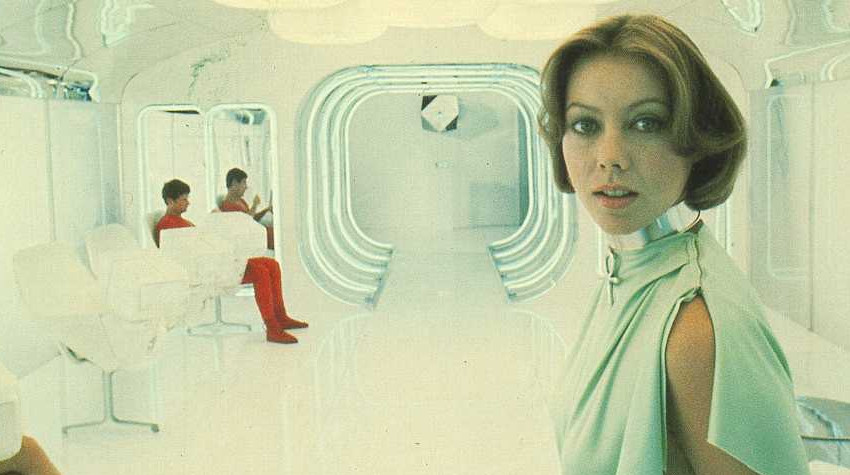
Michael Anderson’s Logan’s Run (1976) presents a seemingly utopian society where pleasure functions as the central principle of life. What initially appears to be a perfect world, however, comes with a disturbing catch: once citizens turn thirty, they must undergo a ceremony called Carousel, a ritual they believe will renew their bodies. Those who escape this process are labeled “runners,” having realized that renewal is actually a machine-orchestrated population control mechanism designed to kill them.
Set in the year 2274, the film presents a dystopian, post-apocalyptic America where the surviving remnants of humanity live in an isolated, computer-controlled domed city. Everything is provided for its citizens: they can shop freely, pursue sexual pleasure whenever they desire, and consume drugs without consequence. Meanwhile, reproduction is managed by a complex computer system that keeps society permanently young by enforcing an age limit of thirty.
At first, the film creates the impression that aging beyond thirty may result in biological decline or death, making the population control system appear necessary. Citizens are conditioned to celebrate Carousel, believing they will be reborn without memories of their previous lives. In reality, the ceremony simply vaporizes them. The spectacle of citizens dressed in robes and masks floating into the air evokes both ritual sacrifice and the consumer excess of the 1970s. Scenes centered on shopping, pleasure, and consumption strongly echo the rise of mall culture, where every desire is fulfilled within a controlled and enclosed environment.
When Logan is tasked by the central computer with locating a place called Sanctuary through the symbol of the ankh, the film begins to unravel its own utopian illusion. Questions surrounding Sanctuary remain deliberately vague, while Logan’s growing skepticism about the “Last Day” and Jessica’s explanation that runners are people who recognize the cruelty of Carousel suggest that humanity previously experienced a catastrophic event. The domed city appears to have been built to preserve the last remnants of humanity from an external threat, yet that preservation has transformed into authoritarian control.
The fashion, colors, and aesthetics of the film strongly reflect the 1970s, reinforcing the artificiality of its society. Sandmen, tasked with hunting and killing runners, function as the policing force that protects the system. Logan’s mission to infiltrate and destroy Sanctuary suggests that resistance has existed since the creation of this social order.
As Logan and Jessica (a woman connected to the underground network helping “runners”) escape the dome, they begin questioning concepts completely foreign to them, including motherhood, fatherhood, marriage, family, animals, and aging. These forgotten aspects of human life reveal how deeply controlled their society truly is. Their encounter with Box, the robot that freezes runners before they can escape, further demonstrates the extent of this manipulation.
When Logan and Jessica eventually encounter an old man in what appears to be the ruins of the Library of Congress, they are confronted with evidence of a world that existed before technological control. Logan’s former friend Francis, unable to accept the possibility of life outside the dome, pursues them and ultimately dies defending the very system that oppresses him.
Logan’s decision to return to the city becomes the film’s most hopeful moment. He seeks to expose Carousel as death rather than renewal and share the truth about life beyond the dome. The outside world represents uncertainty, but also freedom, aging, and “authentic” human experience.
The novum presented by the film remains remarkably creative for its time. Compact futuristic vehicles, Sandmen blasters, teleportation systems used for casual sexual encounters, Box’s freezing technology, and a computer-controlled social order all helped establish science fiction tropes later expanded by franchises such as Star Wars and Star Trek.
The film’s refusal to fully explain what caused the collapse of the outside world allows viewers to speculate. Like much science fiction of the era, Logan’s Run reflects Cold War anxieties surrounding nuclear destruction, environmental catastrophe, and authoritarian control. It captures fears of a society so obsessed with comfort, consumption, and stability that it sacrifices freedom, memory, and human connection.
While some of its visual effects and performances might feel dated today, I see Logan’s Run as a fascinating dystopian science-fiction film that was ahead of its time in its critique of consumerism, youth obsession, and authoritarian control disguised as comfort. The film excels at gradually transforming a seemingly utopian world into a dystopian nightmare, revealing how pleasure and convenience can function as tools of political control. Although certain narrative elements remain underexplained and the pacing occasionally feels uneven, its world-building, social commentary, and imaginative futuristic design make it a memorable entry in 1970s science fiction cinema.

Leave a comment