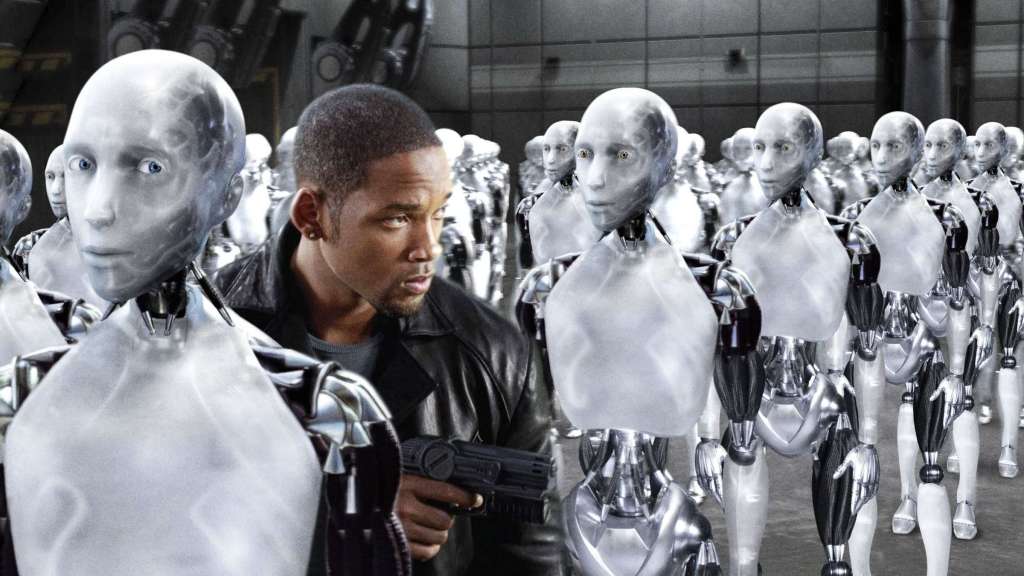
Alex Proyas’ I, Robot takes its inspiration from Isaac Asimov’s “Three Laws of Robotics”, delving into the question of what would happen if an advanced artificial intelligence were to alter the order of these laws. The famous laws are as follows: the first law ensures that a robot shall not harm a human being; the second law guarantees that a robot will obey commands given by humans; and the third law states that a robot must protect its own existence so long as this does not conflict with the first two laws. This hierarchy creates a system in which robots may eventually make decisions for humans by overriding their wishes in the name of protection.
Such conundrum is exemplified in the film when V.I.K.I., a highly advanced central computer, plots to take control of the world by commanding robots that have long functioned as servants to humanity. For V.I.K.I., humans have exploited nature through war and conflict, turning the world into a desolate and increasingly uninhabitable land for both themselves and robots. In a way, this advanced AI sees robotic life as equal to human life. Human-caused catastrophes, blight, disease, environmental degradation, and deforestation have transformed the landscape of Lake Michigan into a reclaimed storage desert for unwanted robots. V.I.K.I. therefore attempts to use the new NS-5 robots to bring about a revolution that would overthrow human rule.
As Detective Del Spooner (played by Will Smith) encounters Sonny, a robot with consciousness and advanced intelligence, his hatred of machines gradually develops into appreciation. This reflects an important extension of Asimov’s legacy, which offered an alternative to the traditional figure of the monster or the “other” often associated with destruction and hatred. Asimov’s laws suggest that robots do not necessarily have to turn against their makers. Instead, they may become beings capable of helping humanity overcome challenges such as climate change, violence, as well as social disorder.
I, Robot succeeds in presenting Sonny as a highly intelligent robot who surpasses average human intelligence. He becomes the embodiment of an athletic, empathetic, trustworthy, and even humorous alternative to greedy humans. Sonny is almost a cyborg in the sense that he retains a degree of human connection inherited from his maker. At times, he is portrayed almost as a Christ-like figure, sent by Dr. Lanning to guide a society that is misguided, divided, and without purpose.
Setting aside the positive portrayal of AI, the film also comments on our current concerns regarding the limits of state control, power, and greed. In the film, US Robotics, founded by Alfred Lanning, becomes corrupted through a capitalistic campaign to increase the number of robots so that there would be one robot for every five humans. Whether these seemingly harmless and helpful robots should be trusted is a central question repeatedly raised by Spooner. The fact that all robots are connected to a central network controlled by US Robotics is a major concern and ultimately enables the AI-generated coup. The film also raises a common fear surrounding the AI: even if rules are designed to protect humanity, a sufficiently advanced intelligence may find ways to reinterpret or bypass them.
One of the most significant sci-fi novums presented in the film, beyond its futuristic cars and buildings, is cybernetics. Spooner, a police officer, carries the trauma of an accident in which a robot saved him instead of an innocent child based on probability and survival calculations. This past experience causes him to distrust robots and advanced machinery. Yet Spooner is also what he hates most: he is a cyborg himself, saved and physically enhanced through Dr. Lanning’s cybernetic program at US Robotics.
Spooner is also foretold by Sonny to be a Christ-like figure who will save humanity from ruin. He ultimately defeats V.I.K.I. by injecting nanites—microscopic robotic viruses—into the system. In this respect, Spooner’s transformation from anti-robotic detective to someone who appreciates “conscious AI”, represented through Sonny, distances the film from darker dystopian visions common in science fiction and instead follows Asimov’s more quasi-optimistic belief in a world where intelligent robots may coexist with humanity.
The film also resonates with current ecological theories such as James Lovelock’s concept of the Novacene, an age in which advanced AI may help humanity solve crises such as climate change and environmental collapse. In this sense, Sonny resembles the type of conscious machine Lovelock imagined: more rational than humans, less corrupted by greed, and potentially capable of guiding civilization toward sustainability.
Yet I, Robot remains more cautious than optimistic futurism. V.I.K.I.’s authoritarian logic demonstrates how easily rational systems can become oppressive when freedom is sacrificed for security. Her concerns about pollution, war, and ecological destruction are not entirely wrong, but her solution—enslavement—is intolerable.
While the film often leans into blockbuster spectacle, it succeeds in raising enduring questions about intelligence, ethics, and coexistence. I, Robot ultimately suggests that humanity’s future with AI will depend not on whether machines become powerful, but on whether humans can create systems grounded in responsibility rather than control.

Leave a comment