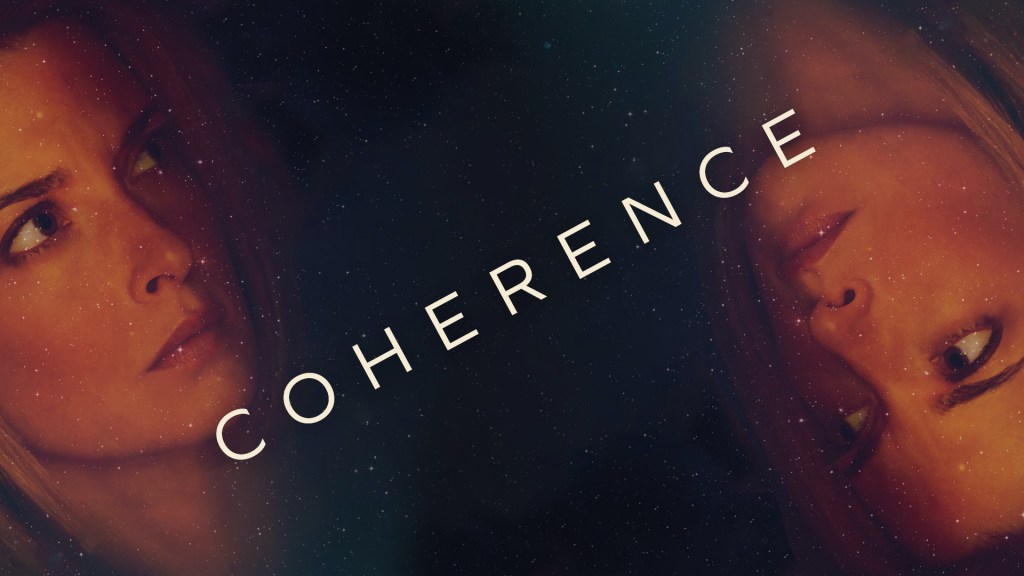
James Ward Byrkit’s Coherence (2013) centers on a group of eight friends who, during the passing of a comet over Earth, become trapped in intertwining realities where they encounter alternate versions of themselves. The comet creates an anomaly in which each character moves back and forth between multiple realities featuring the same setting. The film is a warped take on Schrödinger’s Cat, suggesting that the comet initiates the above-mentioned quantum anomaly that exposes the existence of infinite realities occurring simultaneously. These realities remain imperceptible to humans, who normally experience time in a linear fashion. As the characters move through a dark area functioning like a portal, chaos ensues and their sense of reality begins to collapse.
Although the film initially appears to have an overwhelmingly complex narrative, a closer examination reveals that it consistently follows Emily as the protagonist. What makes the story difficult to grasp is the constant intertwining of nearly identical houses and dinner parties, which obscures who belongs to which reality. The film’s logic derives again from Schrödinger’s Cat, the famous thought experiment in which a cat inside a box is considered both dead and alive until the box is opened. The theory suggests that multiple outcomes may exist simultaneously until one reality is observed. Echoing this experiment, the eight friends exist in multiple realities at once. During the anomaly caused by the comet, their ordinary perception of time is disrupted, and the boundaries between realities become permeable. The film reveals that there is not one single dinner party, but numerous versions of the same gathering unfolding across different realities. The dark area outside the house is a liminal gateway: anyone who steps into it may emerge in another version of the same setting and encounter alternate versions of the group.
One of the most intriguing moments in the film involves a physics book in Hugh’s car, which appears to offer an explanation for the events taking place. Hugh and Kevin go outside to retrieve the book, hoping it will help them understand the anomaly. Although the book itself does not solve the mystery, notes written by Hugh’s brother describe what appears to be a process of quantum decoherence, suggesting that multiple realities exist simultaneously but ordinarily remain separate. The comet seems to initiate this process, allowing access to an infinite number of parallel realities.
When the group attempts to identify their own house by selecting random objects and rolling dice, they discover that other groups in other realities have made the same decision. This reinforces the idea that predestination and repetition shape the anomaly, and that any attempt to restore certainty or linearity is ultimately futile.
Emily gradually realizes that there may be a “best” version of reality—one in which the evening unfolds peacefully and her relationship with Kevin remains intact. Feeling dissatisfied in the reality she currently inhabits, where Kevin appears emotionally closer to his ex-girlfriend Laurie, Emily becomes determined to replace her counterpart in a more desirable timeline. Emily understands that once the comet passes, she will remain permanently trapped in whichever reality she occupies. She therefore travels through multiple versions of the house, observing different combinations of conflict, paranoia, violence, and death. When she finds a seemingly ideal scenario, she lures her doppelgänger outside and incapacitates her with a tranquilizer. Emily then attempts to assume her counterpart’s place.
However, the situation remains unstable. Her injured double manages to return, and Emily ultimately kills her in order to complete the substitution. Yet because other characters have also traveled between realities, this “perfect” world is still vulnerable to intrusion by additional doubles. The ending leaves Emily in a state of uncertainty, suggesting that her attempt to impose coherence has only deepened the disorder.
For me, this ending echoes the unsettling speculative logic of Philip K. Dick’s The Man in the High Castle, which similarly questions the stability of reality and suggests that multiple worlds may exist simultaneously. This surely signifies a complete collapse into chaos, much like the ending of Coherence, in which the possibility of encountering one’s own doubles gives rise to identity theft, suspicion, and violence. In a world where individuals can physically confront and even replace their alternate selves, individuality then itself becomes unstable. Such a reality would likely produce authoritarian forms of control, as the boundaries between self and other, truth and deception, can no longer be trusted.
Despite its modest budget and largely improvised dialogue, Coherence excels at creating an atmosphere of mounting tension and intellectual intrigue. The film turns a simple dinner party into a remarkably effective exploration of quantum theory, fractured identity, and the unsettling possibility that reality may be far less stable than we assume.

Leave a comment