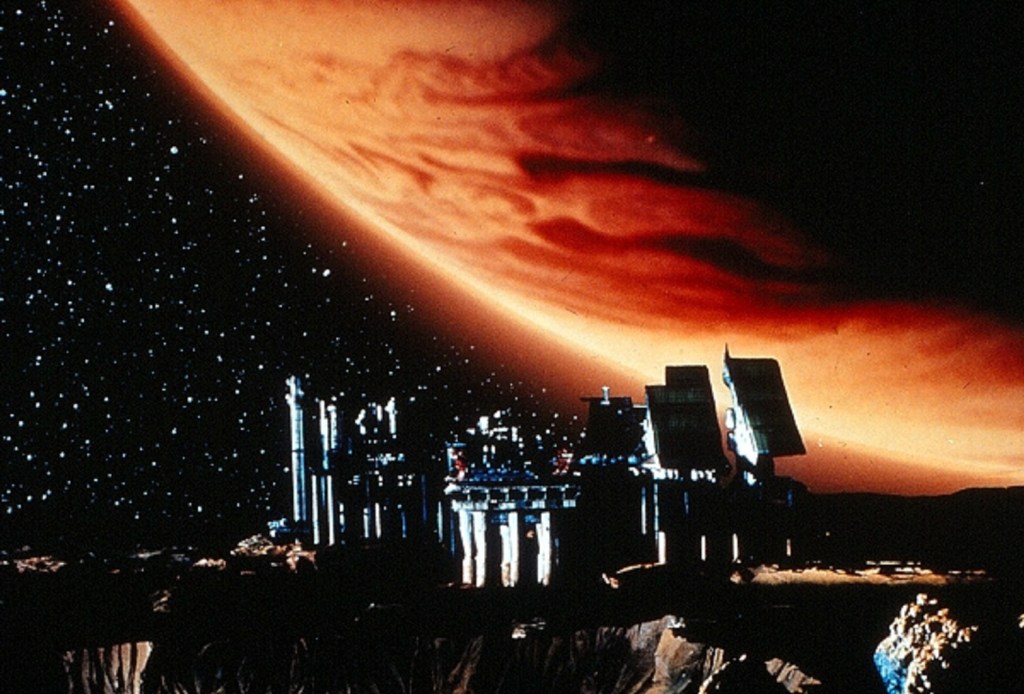
Peter Hyams’ Outland (1981) is heavily inspired by High Noon, featuring Sean Connery as the marshal of a mining colony on Jupiter’s moon Io who struggles to find the necessary support from the community in order to fight injustice. In this film, injustice manifests itself as both the physical and psychological exploitation of workers by corporate power, administered through a hierarchical structure that exerts its influence over the marshal’s department, support units, administrative bodies, and the labor force. The structure of the colony is designed to maximize profit by offering bonus checks while imposing inhumane working hours in order to send as much ore as possible to Earth.
Like Fred Zinnemann’s High Noon (1952), which portrayed injustice through the moral cowardice and passivity of a community unwilling to stand against a threatening outlaw, Outland centers on a lawman who is gradually abandoned by the very people he is trying to protect. Often read as a critique of the oppressive atmosphere of McCarthyism in the 1950s, High Noon reveals how fear and self-interest erode communal responsibility and leave the burden of justice to a single individual. Peter Hyams transposes this same ethical conflict to a futuristic mining colony, where injustice takes the form of corporate exploitation and the systematic abuse of workers. Just as Will Kane is deserted by the townspeople, Marshal William O’Niel is abandoned by his deputies, administrators, and laborers, all of whom are either intimidated by corporate power or too alienated to recognize the conditions of their own exploitation.
O’Niel is betrayed not only by his own deputies but also by workers who are so alienated from their labor that they fail to recognize their exploitation. They are unknowingly addicted to a synthetic amphetamine that induces psychosis and suicide, allowing the mining company to extract greater productivity. In this way, exploitation becomes cyclical: the company pays wages to its workers only to reclaim that money by fueling their drug dependency.
As a reworking of the 1952 western, the film relocates its story to a mining colony on Io, where a series of apparent suicides leads O’Niel into a corporate conspiracy. These deaths are eventually revealed to be caused by a powerful synthetic drug smuggled through the same corporate system in order to enable workers to work extraordinary hours. O’Niel’s investigation implicates the colony’s administrator, who, unable to bribe him, calls upon higher corporate authorities to send assassins.
Once the assassins are scheduled to arrive on the next shuttle, a countdown begins. Because the suspense surrounding their arrival is introduced relatively late, the final confrontation feels somewhat less cathartic than Will Kane’s triumph in High Noon. Both characters uphold a moral commitment to justice that transcends self-interest, yet Kane’s symbolic rejection of the town—removing his badge and throwing it into the dirt—remains more subversive than O’Niel’s implied reunion with his family after defeating the conspiracy.
The film’s emphasis on family drama can be read as part of a broader science-fiction trope in which the dangers and isolation of space are counterbalanced by love and familial bonds. The space western genre had already been popularized by franchises such as Star Trek, which extended the American frontier into outer space. Star Wars similarly combined western motifs with family conflict, while Firefly portrayed a group of outcasts surviving on the edges of civilization. Unlike these works, however, O’Niel finds neither companionship nor meaningful support in his community. Even his family leaves the colony rather than remain with him. He is literally unable to leave town, stranded on a distant moon whose hostile environment requires a protective suit for survival.
O’Niel does, however, gain an important ally in Dr. Lazarus, and together they investigate the cause of the miners’ psychosis. Their partnership highlights the film’s most compelling science-fiction novums. For a film released in 1981, Outland presents remarkably forward-looking technologies, including computer systems that respond to typed inquiries, long-distance video communication, and an advanced surveillance network featuring 360-degree security cameras. The film also includes a motion-activated golf simulator played with real clubs and balls, anticipating later developments such as motion-controlled gaming and virtual reality.
Outland excels not only in introducing imaginative science-fiction novums but also in combining the space western with crime thriller and suspense. Significantly, the film is a sharp critique of worker alienation, corporate exploitation, and the passivity of communities confronted with systemic injustice. The mining colony on Io functions as a closed corporate world in which every institution—from law enforcement to medicine and labor—is subordinated to profit, making resistance appear almost impossible. Sean Connery delivers a restrained and compelling performance as a lawman who remains committed to a fading moral code despite isolation and betrayal. Although the pacing occasionally falters and the family subplot feels somewhat conventional, the film successfully translates the ethical concerns of High Noon into a futuristic setting where capitalism, rather than outlaws, becomes the central threat. In this respect, Outland remains a gripping and underrated science-fiction film whose warnings about corporate greed, worker exploitation, and social passivity feel just as relevant today.

Leave a comment