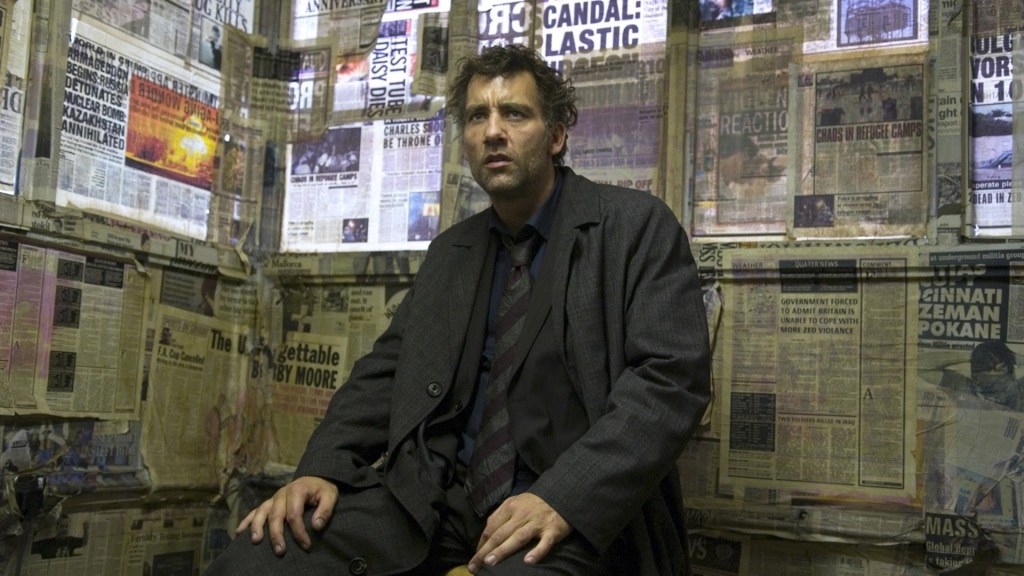
Directed by Alfonso Cuarón, Children of Men (2006) presents a dystopian world in which nations suffer from violent conflict, infertility, religious extremism, terrorist attacks, anti-immigrant policies, and state repression. The film depicts a divided world plunged into chaos, with Britain standing as one of the last functioning states through strict governmental control and heavily enforced anti-immigrant policies. These policies result in refugee camps where violence perpetuates further violence.
The protagonist, Theo, works in the Ministry of Energy and is disillusioned by the overt romanticization of the death of the world’s youngest person, Diego, which is broadcast globally. Early scenes reveal that even urban London—supposedly safe from immigrants and conflict—is marked by constant bombings. Theo’s abduction by his ex-wife Julian, who leads a resistance group called the Fishes, introduces a crucial turning point: a Black woman named Kee is pregnant. Her pregnancy becomes a symbol of hope in a world collapsing under infertility, extremism, and violence.
This discovery initiates Theo’s transformation from a disillusioned alcoholic into a man with purpose. The possibility of restoring fertility carries strong political implications in a world where life has been devalued—where death is both a choice, through state-supported suicide drugs, and an everyday reality. In this sense, humanity itself is no longer treated as a resource. Kee’s child represents the potential restoration of meaning, value, and continuity.
The film also carries strong religious undertones. Kee’s baby, essential for humanity’s survival, must be delivered to a secret organization known as the Human Project. Although the film does not elaborate on this group, it can be interpreted as a supranational scientific initiative, similar to the United Nations, dedicated to addressing infertility. Its secrecy reflects the instability of the global political order, which does not allow such collaborative efforts to operate openly.
Britain, presented as the last fortress, is deeply divided. Massive waves of immigrants are met with hostility, reinforcing class and social stratification. Theo, as a government employee, belongs to a relatively stable middle class, living within controlled urban spaces and expected to remain vigilant against perceived threats. In contrast, refugee camps reveal extreme deprivation and violence, highlighting the inequalities embedded within this society.
Encounters with different social groups further expose these divisions. Theo and Kee are temporarily sheltered by a group of former activists, while the upper elite—represented by Theo’s cousin—live in insulated environments, detached from the chaos affecting the rest of society. This stark contrast underscores how privilege allows certain groups to remain unaffected by systemic violence and instability.
The film’s anti-immigrant policies echo contemporary political realities. Refugees are framed as potential terrorists, mirroring real-world rhetoric often mobilized by far-right movements. Such discourse feeds on fear and constructs marginalized groups as threats to national identity and stability. The film thus critiques how political systems weaponize fear to justify exclusion and repression.
Environmental collapse is another crucial dimension of the film. Industrialization, pollution, and toxic waste have rendered both land and bodies infertile. Background imagery—such as burning livestock—suggests a world suffering from ecological devastation. These visuals point to the consequences of unchecked technological and industrial expansion, where natural systems are exploited to the point of collapse.
This mechanization extends to the treatment of living beings. Kee’s account of farmers modifying animals to fit industrial systems reflects a society that prioritizes efficiency over life. The world of Children of Men is thus fundamentally machine-centered, where human and non-human life alike are subjected to processes of extraction and control.
The film’s novum includes technologies such as advanced surveillance systems, suicide drugs, fertility testing, augmented devices, and solar infrastructure—elements that reflect both technological advancement and authoritarian control. Citizens are encouraged to report suspicious activity, reinforcing a culture of fear that sustains the state’s power.
As noted by the author of the original novel, P. D. James, the film can also be read as a Christian parable. Theo takes on a Christ-like role, guiding Kee—who jokingly refers to herself as a virgin—toward the birth of her child. Yet the film leaves open the question of whether a society so fractured by conflict, inequality, and extremism can truly sustain such hope.

Leave a comment