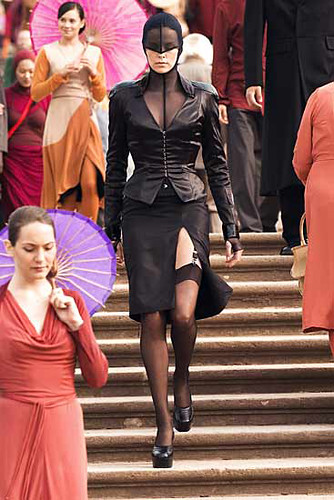
Karyn Kusama’s Æon Flux (2005) takes place in a dystopian commune called Bregna, where a technocratic regime of scientists aims to preserve the last portion of humanity, nearly destroyed by a pandemic. Headed by the lead scientist Trevor Goodchild, the Goodchild family has long been in power in Bregna, which is sustained through cloning practices that aim to eliminate defects in human DNA caused by an unknown virus. However, this “cure” comes at a cost: the vaccine renders women infertile.
Bregna is structured as a walled city-state, designed to protect its inhabitants not only from the virus but also from possible mutations, desolation, and other unknown threats. However, as the main character Æon, played by Charlize Theron, reveals, the real threat comes from within. A resistance movement, the Monicans, operates secretly using pills and bodily augmentations to facilitate communication with their leader, the Handler. The group aims to assassinate Trevor Goodchild, who is held responsible for the abduction of citizens—acts that are in fact orchestrated by his power-hungry brother Oren, who seeks to maintain the Goodchild family’s control by ensuring there is no alternative to cloning.
At the same time, people are taken from the streets of Bregna for experimental purposes, as Trevor attempts to find a cure for infertility. The film’s central idea thus revolves around death as the last remaining marker of humanness within a pseudo-reality constructed by clones. In this sense, death becomes a necessary condition for the restoration of authentic humanity, allowing for a transition from cloned existence to a future of “real” humans.
The dystopian elements of the film—scientific elites, abductions, cloning, and state violence—suggest that Bregna may have originated as a utopian project aimed at protecting humanity. However, as is often the case in science fiction, the real “virus” is revealed to be human corruption, something that cannot be cured through technological intervention or genetic manipulation.
In light of the COVID-19 pandemic, the film invites reflection on issues such as isolation, quarantine, travel restrictions, and the role of state power in regulating everyday life. It also raises questions about inequalities in access to resources, including vaccines, and the widening gap between elites and the general population. As the walls of Bregna are eventually broken and its citizens begin to understand how their reality has been constructed through control and misinformation, the film suggests that enforced isolation may distance individuals from a shared sense of humanity.
The film further critiques the disruption of the “natural order” through cloning. What begins as a utopian attempt to preserve life gradually turns into a dystopian system of repetition and control. If dystopias often emerge from utopian imaginaries, Bregna follows this trajectory closely. As the ending implies, if human nature—presented by Æon as inherently good—is no longer mediated through cloning, the possibility of genuine human reproduction returns, and clones gradually disappear.
At the same time, the film positions cloning as a dangerous technology: a means to an end that should not become an end in itself. Its anti-cloning stance, combined with a somewhat melodramatic emphasis on shared humanity, can make the film feel repetitive and, at times, overly sentimental. Nevertheless, its broader critique of control, subject formation, and ideological conditioning remains significant. The repeated reproduction of figures such as Trevor and Oren across generations illustrates how power perpetuates itself through replication, yet ultimately fails in the face of human individuality.
This theme is further reinforced through the trope of “playing God,” familiar from Mary Shelley’s Frankenstein, where scientific ambition leads to unintended consequences. The human dimension of the film becomes especially visible in scenes where Æon reflects on her fragmented identity, caught between past and present selves. She describes clones as “ghosts,” suggesting that the past continuously haunts the present. Her eventual destruction of the floating cloning structure—a monument to scientific dominance—symbolically breaks this cycle and gestures toward the possibility of a different future.
The film’s novum centers on technologies such as DNA restructuring, cloning, telepathic communication through pills, bodily augmentation, and advanced surveillance systems. Elements such as healing patches and underground transit networks contribute to the film’s speculative world-building. However, the execution of action sequences and the emphasis on stylization—particularly in the final cut—often undermine these innovations, making the film feel uneven despite its conceptual potential.

Leave a comment