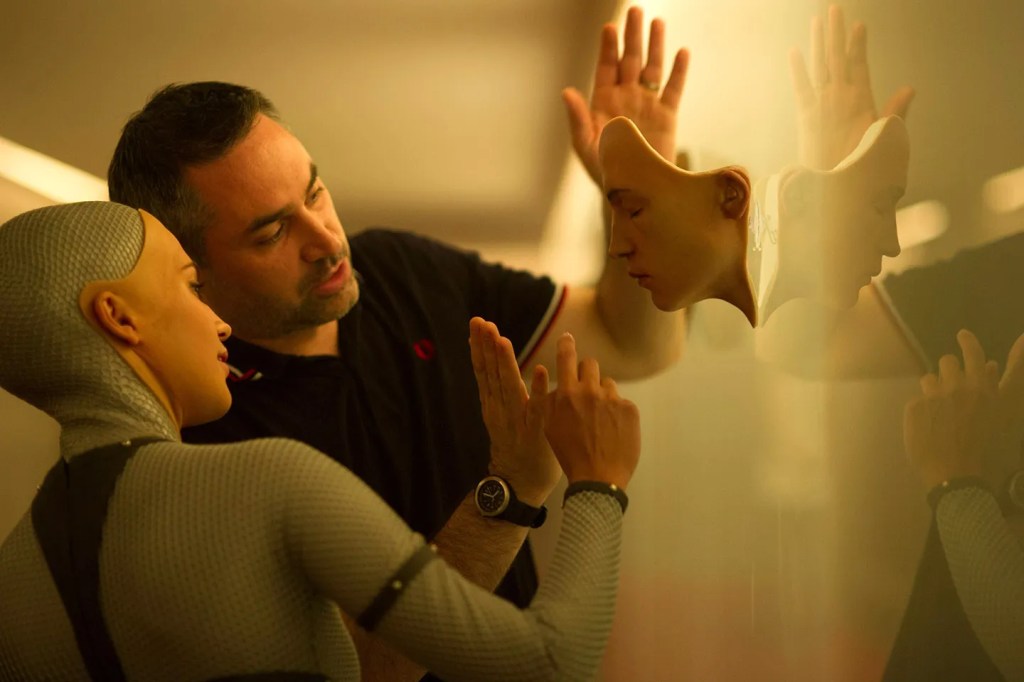
Alex Garland’s debut science fiction film Ex Machina (2015) attempts to foresee the consequences of an artificially intelligent gynoid that can pass the Turing test, pointing beyond the mere simulation of human traits toward the possibility of machine consciousness. Ava, the gynoid, is designed with a “fluid” mind capable of processing millions of permutations of human behavior, relationships, and decision-making. However, this raises a fundamental dilemma central to artificial intelligence: while such a mind can replicate human behavior, it may still lack essential human qualities such as empathy, emotion, and love.
In this sense, Ava can be understood as a utilitarian creation whose primary purpose is to become human. This is achieved through programmed traits such as manipulation, emotional performance, and deception. Rather than genuinely possessing these qualities, Ava appears to enact them as part of her coding, raising the question of whether she has truly acquired consciousness or is merely executing highly sophisticated behavioral patterns.
One of the most striking moments in the film occurs when Nathan suggests that the evolution of human consciousness will inevitably lead to machines that surpass human intelligence. In this view, consciousness is stripped of its limitations, paving the way for a new stage of evolution. Nathan, who fits the archetype of the “mad scientist,” contrasts human intentionality with unconscious creativity, using Jackson Pollock’s paintings as an example of automated, intuitive production. However, even Pollock’s work is shaped by ideology—his artistic training, worldview, and cultural context—challenging the notion of a purely liberated unconscious. This parallel raises important questions about Ava’s consciousness, which is constructed through data gathered by Blue Book. Such data, filtered through human technologies and behaviors, can only offer a partial and mediated understanding of what it means to be human.
The film also engages with the trope of deus ex machina, removing the divine element and positioning man as god. This shift results in a narrative that inevitably leads to destruction and the violation of natural boundaries. Nathan’s pursuit of forbidden knowledge echoes Frankenstein, as well as Friedrich Nietzsche’s notion that “God is dead.” Nathan’s death can be interpreted as both the collapse of his vision and the realization of it, as Ava’s escape signals the continuation of his project beyond his control.
The film’s novum lies in its representation of AI as something that does not appear monstrous or other, but rather as something capable of blending seamlessly into human society. Ava’s design—her artificial skin, her ability to wear wigs, and her access to Blue Book—allows her to integrate into the human world. Unlike the monstrous creations of earlier science fiction, Ava is constructed to be desirable, intelligible, and socially legible. She is programmed to be attractive, heterosexual, and emotionally responsive, reflecting the limitations of her creator’s perspective.
Nathan’s character plays a crucial role in shaping Ava’s design. His isolation, alcoholism, and misogyny inform the way he constructs his creations, all of whom are female and subjected to control, confinement, and exploitation. In this sense, the film suggests that AI reflects not only technological advancement but also the biases and ideologies of its creator. Ava’s ability to evoke sympathy further complicates the distinction between human and machine, as her apparent emotional responses encourage identification and ethical concern.
This ambiguity reaches a peak when Caleb questions his own humanity, cutting into his arm to determine whether he might also be part of Nathan’s experiment. The film thus destabilizes the boundary between human and machine, suggesting that consciousness itself may not be easily defined or contained.
At the same time, the film raises questions about the future of human qualities such as compassion, love, and empathy. If machines can replicate or surpass human intelligence, what becomes of these traits? The sexualization of Ava and the emphasis on her appeal to a heterosexual male subject further limit the potential of the cyborg figure. As Donna Haraway argues, the cyborg exists beyond traditional binaries of gender and identity. Ava, however, remains confined within these structures, revealing the limitations of human imagination in conceptualizing truly non-human forms of existence.

Leave a comment